About LingoDesk

LingoDesk is built and run by one person. This page says why it exists, how it was made, what it deliberately is not, and which facts about the person behind it have not been published.

Why this exists

The desk research described below kept returning the same picture: the business runs on a spreadsheet, with a word processor for the invoices, a separate accounting app, a bank and a calendar around it. That arrangement works, in the sense that invoices go out. It also means one job gets typed in several times and nothing in the chain understands what the work actually is.

Nothing in that chain knows what a per-word rate is, what a fuzzy-match tier does to a line total, or why a job with a minimum charge is priced differently from one without. So the pricing happens in the spreadsheet and the result is retyped into a tool that treats it as a flat sum. LingoDesk exists to make one tool in that chain the one that understands the work — the thing it competes with is the spreadsheet and the four tools around it, not another general product with a translation label on it.

The product

How it was made

What the research produced is a list of pricing mechanics that general business tools do not model. Each one is checkable inside the product rather than asserted here:

What LingoDesk is

  • Per-word rates, held per language pair rather than per client.
  • Fuzzy-match tiers, applied against the full rate on the same invoice line.
  • Rush surcharges and minimum charges, which the research kept describing and which a general invoicing tool has no field for.
  • Invoicing and revenue tracking in more than one currency, because the work crosses borders by default.

What LingoDesk is not

LingoDesk is not a CAT tool.

  • There is no translation memory in it, no terminology base and no segment alignment, and none is planned. It does not open a bilingual file and it will not produce a match analysis. It prices the analysis an existing tool already produced, and it invoices the result.
  • It is not an accounting package, a tax filing service or a payment processor either. It records what was billed and what was paid. A bookkeeper and a tax adviser still do their own jobs, and this page is not going to imply otherwise in order to look larger.

This was built from outside the profession

It started with desk research: published industry writing, professional association material, translator forums and vendors' own documentation, read and written up as secondary sources. That work is real, and it is secondary. No interviews were conducted, no survey was run and nobody was polled.

That is why no percentage, no population figure and no market size appears anywhere on this page. A number carried over from secondary reading arrives with no instrument attached to it, and a figure a reader cannot trace back to a source is decoration. The method can be described honestly. The numbers cannot be quoted honestly, so they are not quoted at all.

I have never worked as a translator.

LingoDesk was built from research about the work rather than from having done it. Saying that here costs a sentence and prevents a reader assuming the flattering version, which would be wrong. It also sets the limit on what this product may claim: where the research and a working translator disagree, the translator is right, and the only way to find that out is to be told.
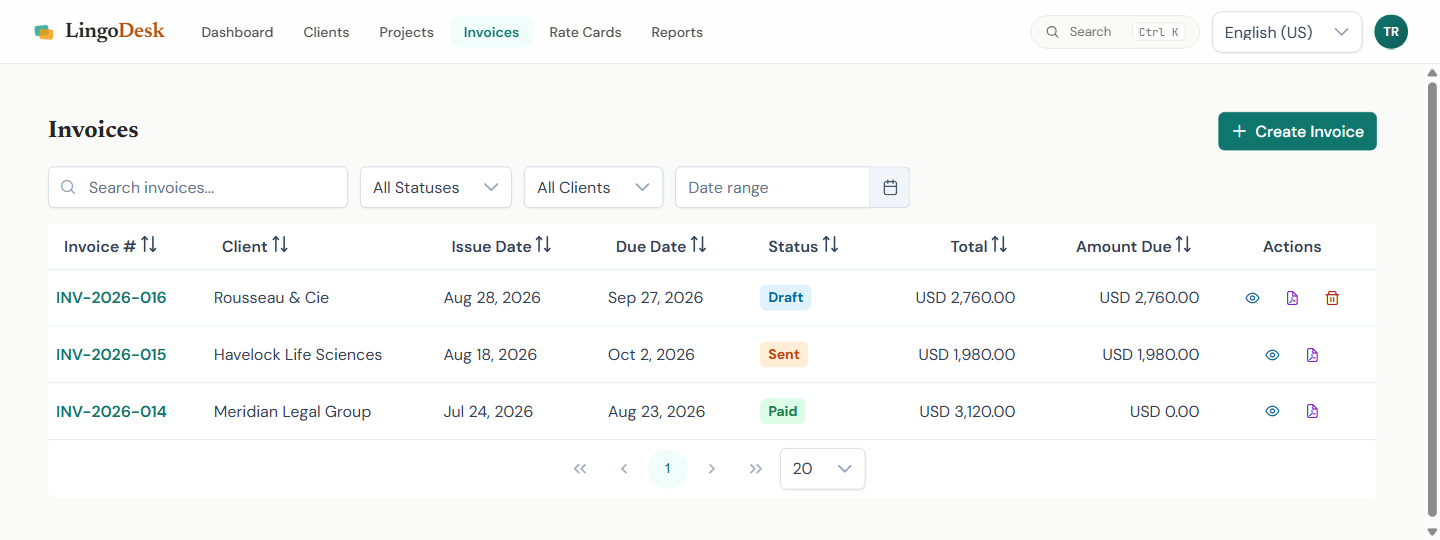
The invoice list, showing issue date, due date, status, total and amount still due for each invoice.

Who is behind this, and what is not published yet

In short: LingoDesk is run by one independent operator in Las Vegas, Nevada, reachable at a real address. Four things a reader would reasonably want to know about that person are not published, and each one is named below instead of being filled in.

LingoDesk is operated by a single independent operator located in Las Vegas, Nevada, United States. That operator is the same party described as the controller in the Privacy Policy and as the provider in the Terms of Service.

One address reaches that operator, and it is the same address used everywhere else on this site:

support@lingodesk.net

Four facts about the operator are not published

The operator's real name, that operator's actual professional background, a photograph and any verifiable public profile are all unpublished on this site.

  • The name. Not published — which is also why the machine-readable description of this page names the organization and no individual at all. There is no person in it, rather than a placeholder person.
  • The professional background. Not published, which is why the section above states only what is not the case and puts nothing positive in its place. There is no career summary on this page, and the absence is deliberate rather than an oversight.
  • A photograph. Not published, and a stock portrait is not going to stand in for one. A face that is not the operator's is a fabrication that takes one reverse image search to expose.
  • A verifiable public profile. None is published, so no link to one appears anywhere on this site. An empty list of profiles is a broken signal rather than a neutral one, so none is offered.

I would rather tell you a fact about me is missing than publish a plausible-looking one.

That is the position the Privacy Policy already takes about its own missing identity facts, and it applies harder here. A background invented for a founder page is the one claim on this site a reader has no way to check, in a profession small enough that somebody would try. It would also be permanent: indexed, repeated back by answer engines and impossible to withdraw.

The Privacy Policy keeps a register of everything on this site that is unsettled, what the best available answer is on each one, and the event that would settle it. Two of its rows are the legal entity name and the registered postal address, missing for a different reason than the four facts above: an entity is not a person, and neither one is ever filled in from the other. Read the open-items register

No customer's words appear on this page

LingoDesk has no customers yet, so there is nobody to quote and nothing is quoted.

3

Pricing plans, each priced for one person

14days

Free trial on every plan

25

Invoice currencies available from the start

22

Languages the interface is translated into

A quotation from a person who does not exist is the cheapest thing a marketing page can carry and the most damaging thing to be caught carrying. When there are people who have used the product and are willing to say so under their own names, what they say goes here — and not one day sooner.

What is committed in writing

In short: a claim about the past cannot be checked from this page, but a published contractual term can be. What follows is what the Terms of Service commit to, and the one thing they deliberately refuse to commit to.

Getting the data out

Every invoice can be exported as a PDF document at any time, and revenue reports export as CSV files. Both are self-service. There is no one-click export of a complete account, and the Terms of Service say exactly that rather than letting the word export imply something wider. A full export, or deletion, is done by hand within 30 days of a request that can be verified.

What happens when the contract ends

Data is kept for 30 days after the contract ends, and during that window an export or a deletion can be requested. After it, the data is deleted, apart from records the law requires be kept. That is a clause in a contract rather than a promise on a marketing page, which is precisely why it is worth more than one.

What is deliberately not committed

There is no availability promise and no service-level agreement. Section 8 of the Terms of Service says why: with no uptime monitoring and no status page, a percentage could not be measured, reported against, or admitted to when it was missed. A figure nobody can observe would be decoration.

See the desk for yourself

Fourteen days, every feature, no card required. The product makes the rest of the argument.